At a Glance
2. Career pathways and employer recognition are concerns for graduates, and many law schools.
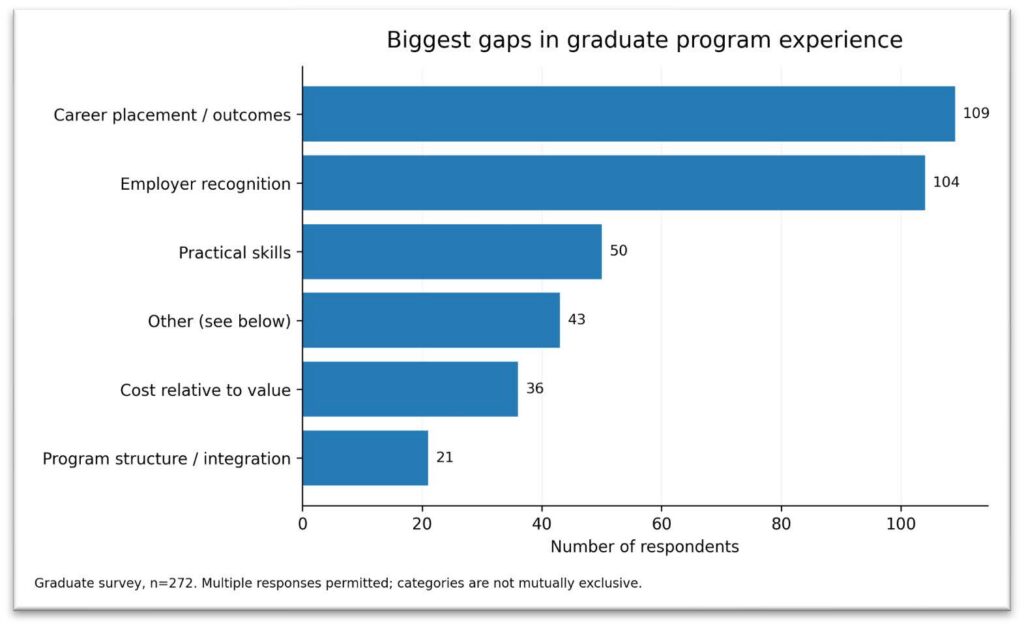
Among graduates, career placement/outcomes was selected by 109 respondents and employer recognition by 104. Those were the two most frequently identified gaps in the graduate survey.
The law-school survey points in the same direction. Employer recognition was the most frequently identified challenge, selected by 18 of 36 respondents (50%).
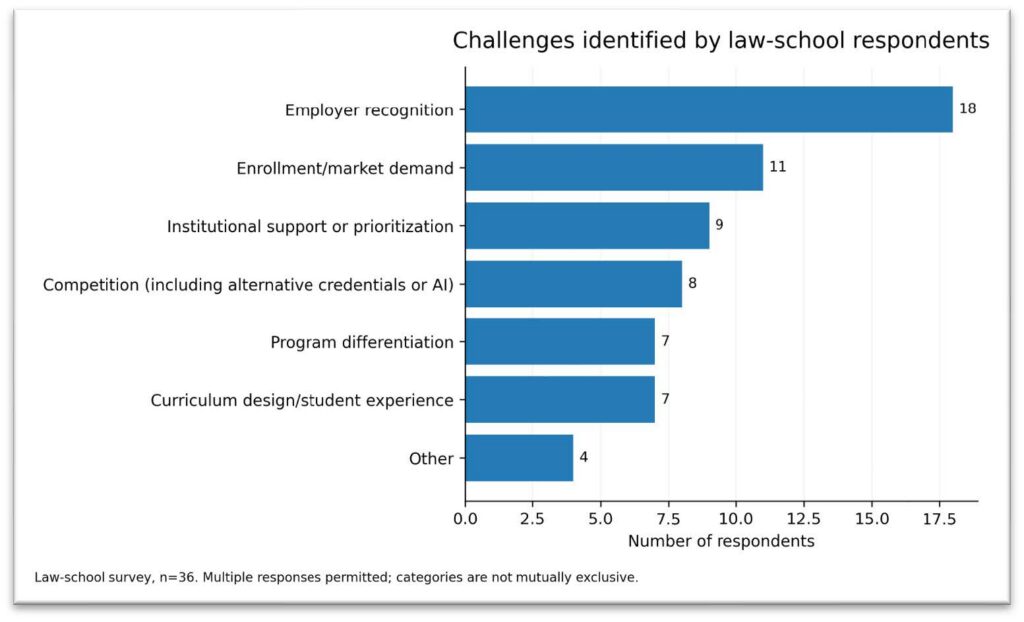
The convergence is notable. Graduates describe difficulty explaining the degree and its value to employers; law-school respondents identify employer recognition as the field’s leading challenge.
Law-school advisory discussions add an institutional dimension: participants described limited capacity to provide dedicated career services for legal masters students and suggested that NLMA explore whether some career coaching or career-services support could be provided collectively across institutions.
3. Graduates are asking for an organization that helps build the professional ecosystem around the degree.
When asked what would be most valuable from an organization like NLMA, graduates most frequently selected advocacy and recognition of the degree, career pathways and job opportunities, professional connections, and continued learning or skill development.
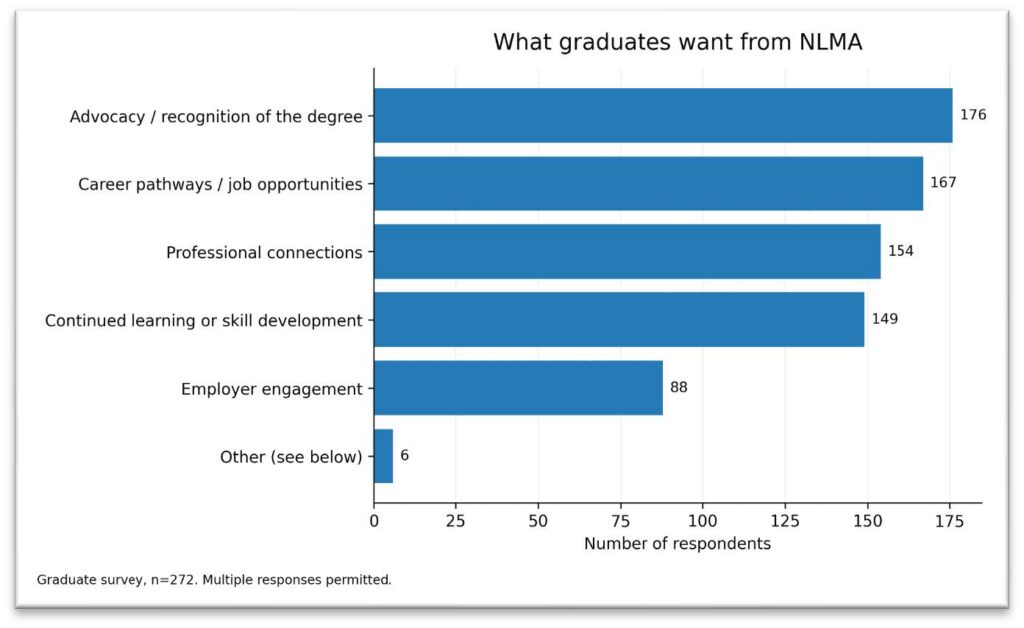
These responses suggest that graduates are looking for more than a stronger public profile for the degree. They also want ways to continue developing professionally, connect with peers across institutions, and translate their legal education into recognizable professional value. Given that many legal masters degrees are drawing prospective students away from an MBA or other comparable graduate degree, institutions would be well advised to meet those expectations.
4. What comes after the degree?
The survey and early focus-group conversations raise a question NLMA wants to explore further: whether legal masters graduates need forms of professional development and demonstrated competency that traditional degree programs do not easily provide.
Focus-group conversations raised interest in opportunities that could sit alongside or follow the degree. Focus group participants urged us to study opportunities for:
- continuing education
- specialized credentials or certificates
- ways to demonstrate current or specialized competencies
- mentoring
- career boards and career transition resources
- intentional networking among graduates from multiple schools and programs
- stronger connections to specialized employers and professional associations
This is an especially interesting area for further research because it potentially connects a graduate need with an opportunity for collaboration across institutions. At this stage, NLMA is treating these possibilities as research questions, not proposed products or services.
5. Law schools are identifying opportunities for shared infrastructure.
The law-school perspective adds another dimension to the findings. Programs vary considerably in their institutional role and resources, but advisory discussions identified several needs that may be difficult for individual programs to address on their own. Among those areas:
- Career support. Participants suggested exploring collective career coaching or career-services support for schools that lack dedicated resources for legal masters students.
- Data gathering and analysis. While schools often survey students for marketing purposes, focusing on incoming cohorts, benchmarked surveys and comparative reports of graduates that would allow participating schools to compare their graduates’ experiences and outcomes with national results.
- Specialization networks. Program managers saw advantages of connecting recent program
graduates with specialties with similar graduates from other schools for networking, and an
enhanced sense of professional identity. - Limited Licensing. Law schools in states with limited license opportunities, or where such legislation has been proposed, seek to explore how legal masters programs might interact with this emerging field of practitioners. Every state is model is different and some program managers would welcome opportunities for information sharing across state lines and institutions.
Advisory participants also discussed whether schools might be willing to support such services financially. NLMA is not yet drawing conclusions about demand, pricing, or the appropriate model. Instead, these discussions point to questions worth testing: What services are most needed? What could be done more effectively at a national level? And what information would schools find valuable enough to support financially?
NLMA expects to continue this work through additional graduate focus groups, surveys, advisory discussions, and research with other constituencies. The timing and design of future research will be shaped in part by what we learn from the current work and by the willingness of law schools, graduates, employers, and others to participate.
About the Research
This snapshot draws on NLMA’s graduate community survey (272 responses); an earlier law-school survey (36 responses); graduate focus groups; and law-school advisory discussions conducted in 2026. A small follow-up survey of focus-group participants was used primarily to assess the focus-group experience rather than as substantive evidence about the field.
The surveys were distributed through NLMA’s developing community network and participating contacts. Neither survey was designed as a probability sample, and NLMA does not yet have enough information to assess how closely respondents reflect the full population of legal masters graduates or programs. Several questions allowed multiple selections, so counts from those questions should not be added together.
This is an early research snapshot. As NLMA’s research base grows, subsequent reports will revisit these themes, add perspectives from employers and other constituencies, and test whether the patterns identified here persist.
About the Authors
Rebecca Purdom is a co-founder and board member of the National Legal Masters Association. Catherine Barnard is an Assistant Teaching Professor at Sandra Day O’Connor Law School at Arizona State University, and a member of the NLMA Founding Steering Committee.